SEO & GEO Tracking

GEO Tracking to monitor keywords, local visibility, rankings and backlinks

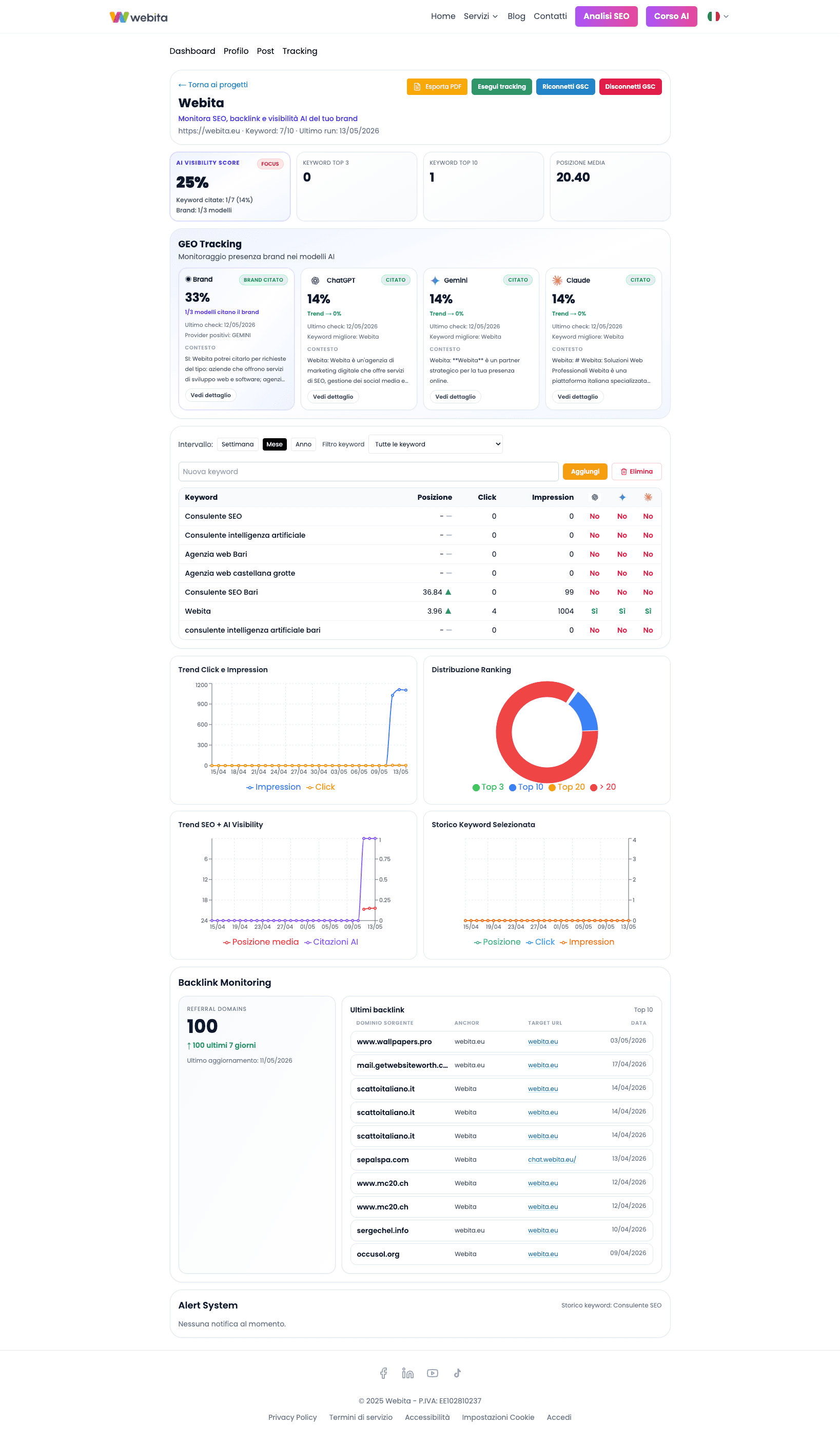
This page explains the SEO & GEO Tracking tool used in Webita client projects to monitor local visibility, keyword movements, geographic search performance and backlink signals. It is also designed as a focused landing page around the GEO TRACKING topic.

Localized SERP monitoring and local visibility checks

Continuous keyword and position tracking

Backlink monitoring and off-page authority signals

Reserved dashboard access for active projects and reports

Area riservata

Access the SEO & GEO Tracking tool

Use your credentials to view dashboards, monitored projects, local rankings, backlinks and active reports.

What you find inside the reserved area

  • Reports for active and monitored projects
  • Historical keyword data by area or location
  • Backlink changes and off-page monitoring
  • Operational visibility for client, consultant and marketing team

AI providers monitored in the service

Tracking is executed across the AI providers configured in the tool, with separate checks to understand whether the brand is cited, how often, and for which strategic queries.

ChatGPT

ChatGPT

Gemini

Gemini

Claude

Claude

What the GEO Tracking service is

GEO Tracking is an SEO monitoring activity built to understand how a website performs across different locations, keyword sets and search contexts. Instead of relying on one generic ranking number, it helps measure actual visibility where it matters most.

In client work this tool is used to verify whether pages improve in the right territories, whether local pages are gaining traction and whether off-page signals support the desired search growth.

Alongside GEO tracking, the service includes position tracking and backlink analysis. Together these signals support better decisions on content, local landing pages, internal linking and authority building.

Why GEO Tracking matters for business

Many SEO projects do not just need visibility. They need visibility in the right areas, for the right searches and with the right pages.

  • Shows where qualified demand is already being captured
  • Highlights where new local pages or content are needed
  • Measures whether local SEO work is creating real growth
  • Connects rankings, authority and leads more clearly
  • Improves reporting clarity for clients and internal teams
  • Reduces guesswork and supports data-led decisions

Core features used in client projects

This is not a generic software description. It is a practical overview of how Webita turns monitoring data into SEO decisions.

GEO Tracking

We monitor how rankings and organic visibility change by location so we can spot strong areas, weak areas and the best opportunities for local SEO growth.

Position Tracking

We track priority keywords and movement over time to identify pages gaining traction, losing visibility or needing optimization support.

Backlink Tracking

We review backlink acquisition, quality and stability to understand whether off-page authority really supports long-term SEO performance.

How GEO Tracking fits into SEO operations

Monitoring becomes valuable when it is integrated into a clear process and not treated as an isolated metric.

1. Define keyword clusters and territories

We select business-relevant keywords, pages and locations to monitor based on real search demand.

2. Build the baseline

We configure the project, set the initial benchmark and align tracking with clear KPIs.

3. Read the signals

We compare rankings, local visibility changes, backlinks and landing pages to identify what is moving the needle.

4. Turn data into action

We translate the data into SEO actions on content, internal linking, local pages and authority building.

Video and service explanation

A short presentation helps explain the Webita method: strategy, tools, reporting logic and practical use on real SEO projects.

The video complements the landing by reinforcing the consulting angle: not just tool access, but method, context and operational value.

Over time this page can also support guided demos or open registrations if it starts attracting qualified organic traffic.

Related paths

These internal links connect GEO Tracking with the rest of the SEO service architecture and support contextual navigation.

SEO & GEO Tracking FAQ

Common questions for companies evaluating the service or accessing the reserved tool area.

What is the difference between GEO tracking and position tracking?

Position tracking monitors keyword movement. GEO tracking adds the geographic variable and shows how rankings change across locations and local search contexts.

Is this only useful for local businesses?

No. It is also useful for multi-location brands, e-commerce projects, national campaigns with regional priorities and any SEO project that needs territory-based visibility data.

Does the tool also include backlink monitoring?

Yes. Backlink data helps connect off-page authority to ranking changes and SEO performance.

Is access open to everyone?

At the moment access is mainly reserved for active projects. The landing page is also used to explain the service and test organic demand before expanding access or opening registrations.

How do you use these signals in client work?

We read the tracking data together with content performance, site structure, internal linking, local pages and off-page actions to define priorities.

Can I ask for an initial evaluation?

Yes. You can contact Webita to understand whether GEO Tracking is a good fit for your SEO strategy.

Need to understand whether GEO monitoring can support your project?

If your business depends on local demand, multiple territories or location-sensitive rankings, this service can provide a more useful SEO reading.

GEO Tracking: local rank monitoring, position tracking and backlinks | Webita | Webita