AI Visibility: how to measure mentions, citations and sources in AI systems
A method to measure the presence of a brand in AI responses: prompts, mentions, quotes, sources, competitors, trends and data limits.
SEO & GEO Tracking
Track brand, keywords and visibility across Google and AI models
A dedicated dashboard to monitor strategic queries, brand mentions and GEO signals.
Indice: Where a brand can appear
Let’s discuss your project
If this resource touches a strategic topic for your business, get in touch and we can evaluate the next steps.
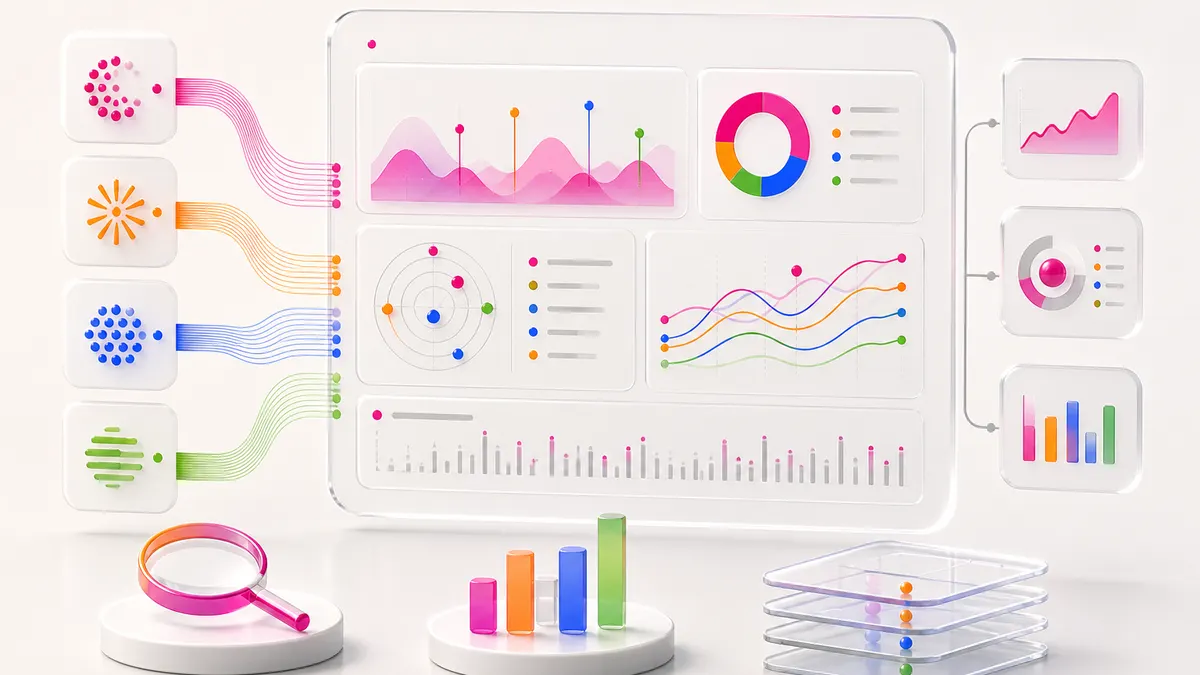
AI Visibility indicates how and how a brand appears in responses generated by systems based on artificial intelligence. It does not coincide with traffic from ChatGPT or Google ranking: it includes mentions, quotes, description accuracy, sources used and presence compared to competitors on a defined set of questions.
Measuring is used to transform occasional impressions into comparable data. The result is not an absolute percentage of the market, because no one observes all real user prompts. It is an estimate built on a documented sample, useful if method and limits remain visible.
Where a brand can appear
The presence can emerge in a textual response, in a quote with links, in a list of alternatives, in a comparison or in the description of a category. Google AI, ChatGPT, Gemini, Claude and other systems do not necessarily use the same sources or produce answers with the same format.
For this reason it is necessary to distinguish:
- mention of the name without connection;
- quote of a page of the site;
- quote of an external source that speaks of the brand;
- explicit recommendation or simple inclusion;
- correct description, incomplete or incorrect;
- lack of the brand as competitors appear.
Build a useful prompt set
The sample should represent the decision path, not only brand queries. A balanced structure includes:
- questions about the problem before the user knows a solution;
- category research and use cases;
- comparisons and selection criteria;
- questions about suppliers or products;
- brand queries, reputation and verification;
- prompt in languages and markets really served.
Each prompt must be associated with relevant intent, country, language, segment and competitor. Changing constantly questions makes it difficult to read the trend; keeping them unchanged forever ignores the evolution of the market. It should distinguish a stable nucleus from an exploratory group.
Main metrics
Mention rate and citation rate
The mention rate measures how many answers the brand appears. The citation rate considers how many answers cite a source connected to the brand. The two metrics are not equivalent: a system can appoint a company without linking it, or quote a guide without mentioning it in the text.
Share of visibility
Compare the presence of the brand with a declared set of competitors on the same prompts. The value depends on the sample and does not represent a market share. It is useful to identify topics in which other subjects are mentioned more often.
Accuracy and context
Being present is not enough if the offer is described badly or associated with the wrong segment. Quality control evaluates claims, tone, attributes, products and possible obsolete information.
Source coverage
Record quoted URLs shows which domains feed responses. You can distinguish proprietary sources, media, directories, documentation, forums and competitor sites. The occurrence of a source suggests where to deepen, does not authorize to replicate its content.
Repetition and variability
Generative responses are variable. The same prompt can produce different results in subsequent executions or change with model, session, position and product updates. A single question generates a fragile figure.
A more robust protocol repeats prompts, keeps full output and calculates distributions or intervals, not only punctual values. Data, model, methods of research and language must accompany every observation.
Dashboard and reporting
A useful dashboard does not compress everything in a score. It should allow you to switch from trend to single answer and show:
- procedure of mentions and quotations;
- results for motor, theme, language and intent;
- comparison with declared competitors;
- more used sources and URLs;
- prompt with incorrect descriptions or relevant absences;
- History of changes made on the site.
Webita presents a service AI visibility monitoring that includes brand, keyword, quotes and SEO data. Its most useful function is to link AI observations to a wider context, not replace Search Console or analytics.
AI Visibility, SEO and GEO
The measurement indicates where gap exists; the GEO defines how to intervene. The resource on GEO advice deepens content, sources, entities and accessibility. SEO continues to provide data on pages, queries, indexing and traffic.
A brand can be quoted in an answer without receiving clicks, and a page can have excellent SEO performance without being used in an AI output. Reading systems together avoids premature conclusions.
Turn data into actions
Each gap should lead to a diagnosis, not automatically to a new content. If a source is incomplete, it updates. If multiple pages compete on the same theme, they consolidate. If the brand is described inconsistently, institutional information and verifiable profiles are corrected.
The roadmap may include:
- accessibility and indexing corrections;
- update of pages already authoritative;
- new resources only for uncovered needs;
- improvement of sources, authors and evidence;
- internal linking and consistent structured data;
- editorial reports and authentic quotes;
- new measurement after an appropriate interval.
Limits to be declared
Monitoring prompts are a real behavior proxy. Results can be customized and platforms change. Not all answers expose sources; not every mention generates attention or revenues. The correlation between intervention and change does not prove a causal relationship alone.
A serious report keeps these limits and separates data observed by interpretations. The SEO Webita advice can integrate AI visibility, organic data and commercial objectives in a measurable roadmap.
Frequently Asked Questions
What measures AI Visibility?
It measures the presence of a brand in a defined sample of AI responses: mentions, quotes, context, sources and comparison with competitors. It does not represent all the real questions of users and must be read together with the method used.
Mention rate and citation rate are the same?
No. The mention rate counts the answers that name the brand; the citation rate counts those that connect or use an associated source. A brand can be mentioned without links, or a page can be mentioned without an explicit name.
What is the share of visibility AI?
It is the brand’s presence rate compared to competitors defined on the same prompts and in the same sample. It is not a market share and changes if questions, engines, languages or criteria change.
Why does the same prompt give different results?
Generating systems can vary output between executions, models, sessions, countries and updates. For this a reliable measurement repeats prompts and keeps context, date and full response.
Does AI visibility always generate traffic to the site?
No. An answer can mention a brand without producing a click. The value may concern recognition or influence on choice, but it must be connected when possible to referral, brand research, lead and other signals.
Any gap requires a new article?
No. Often the problem is an incomplete page, inconsistent information, technical accessibility or weak sources. Before creating content you should diagnose the cause and improve what exists.